How to Make a Page Secure Again
Running a secure website is one of the virtually important elements to consider for your online presence. Whether you've had a website for a long time, or you've merely created one, site security is extremely important — peculiarly for ecommerce sites. Not only that, but any site that requires or stores any kind of visitor data, including something as simple equally login information, should provide security to site visitors.
On this page, we'll answer your burning questions like what it ways when your website isn't secure and how to brand your website secure once and for all! And don't worry — you're non alone! Hundreds of searchers per month inquire Google "why my website is non secure." Keep reading to learn more!
Video: Why isn't your website secure?
What does "not secure" website mean?
If you've visited a website, (perhaps even your own), and noticed a warning in the search bar that says, "not secure," yous're no stranger to feeling cautious upon entering the website.  Yous might ask yourself questions similar "what does 'not secure' website hateful?" or "what information isn't secure?" These are both valid questions and something that you should be enlightened of before entering a website that has the dreaded warning in the search bar.
Here are some things y'all should know when information technology comes to websites that aren't secure:
HTTP websites are not secure
HTTP, or Hypertext Transfer Protocol, is placed at the front terminate of website URLs in order to display a website. Information technology'southward a protocol used by the World wide web in club to fetch HTML documents — or in short, display spider web pages. Unfortunately, website URLs that are preceded past HTTP are not secure.
This means that your login info, or worse all the same, your personal information like credit card numbers, could be stolen, read, or modified by hackers. Y'all tin read more most how HTTP affects site rankings farther downwardly the page.
HTTPS websites are secure
On the other hand, website URLs that are preceded past HTTPS are secure. This means that when y'all come across a website URL starting with HTTPS, yous won't get a "non secure" alert, and you don't have to worry about the possibility of hackers stealing your personal information that y'all use on the website. Popular websites like Google.com and Amazon.com utilize HTTPS to show users that they are safe when browsing and making purchases on their websites.
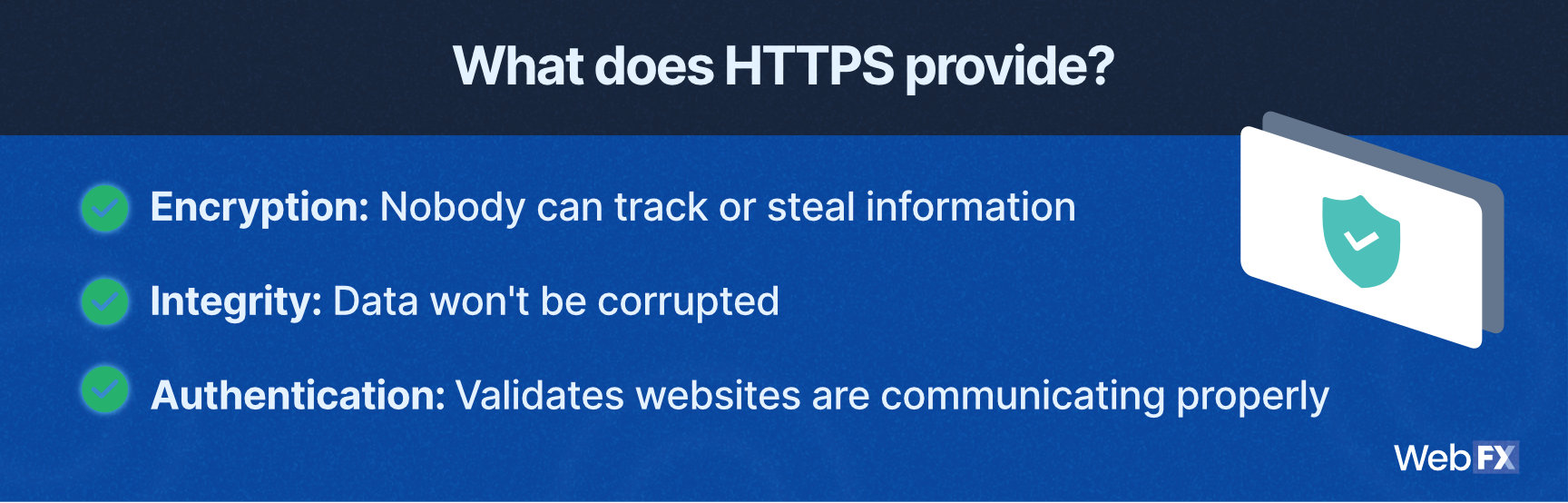 HTTPS provides encryption, which ways nobody tin can track or steal personal information, integrity, which means that information can't and won't be corrupted during transfer, and authentication, which validates that websites are communicating correctly with the right website. Google has always advocated for HTTPS sites as opposed to HTTP sites, just in 2018, they made that even more clear. Starting in July 2018, the search engine started providing users with the "not secure" mark in the search bar — potentially decreasing site visitors to insecure sites.
"Not secure" doesn't hateful your computer is infected
When users see a "non secure" warning, they may think that information technology's the beginning sign of a computer virus or malware. That's one thing yous don't have to worry about! Like we mentioned earlier, the "not secure" warning simply ways that your information is not secure on that website and that you should refrain from entering any personal information.
Websites that don't utilize HTTPS could rank lower in results
Google's main chore as a search engine is to provide users with the results that most closely fit their search query. The results that Google provides for any given search are based on tons of factors including keyword targeting, the domain authority of the website, number of backlinks, and the list goes on. 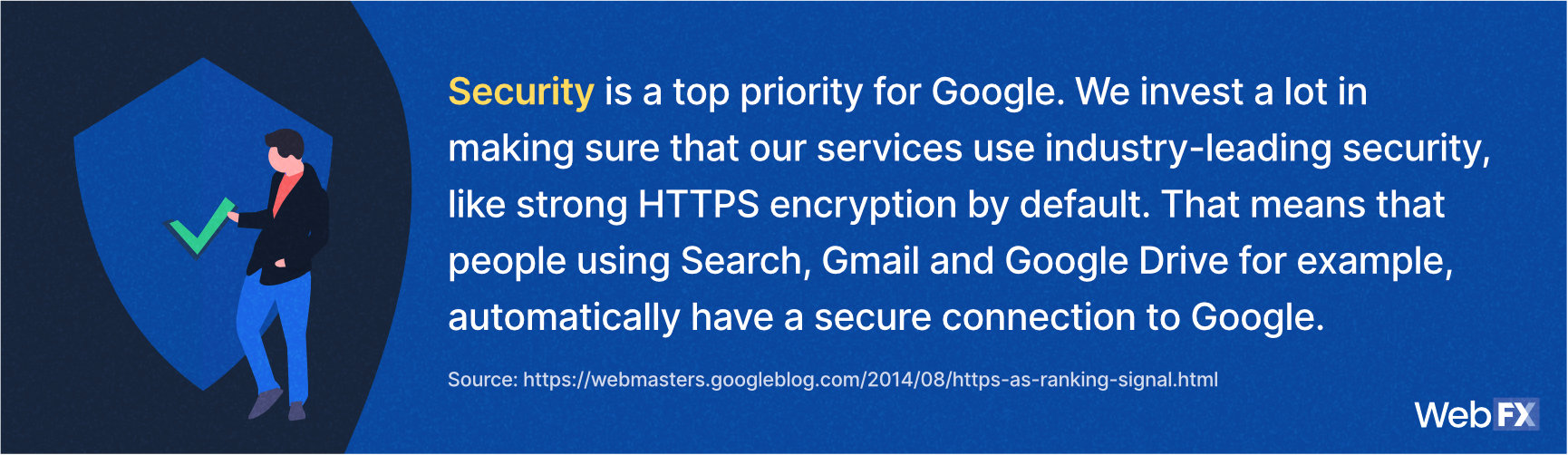 Merely Google is besides known to utilize website security as a ranking factor — meaning if you own a website that doesn't utilize HTTPS, you lot may see your site rankings get worse.
Google wants to provide search results that not only fit a user's search query, but also provides them with a secure feel.
My website is not secure, how can I fix it?
If all this talk well-nigh tanking rankings have you questioning how you can make your website secure, yous've come to the right place. Adopting HTTPS is far from difficult, so check out our v-step procedure to securing your website for site visitors and customers.
1. Install Secure Sockets Layer (SSL) document
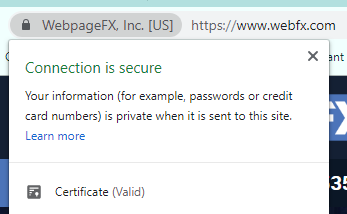 In order to make your HTTP site secure, you'll need to install an SSL document on your website. When you install an SSL certificate, a few exchanges take identify, which provides a secure version of your website to your site visitors.
- Your browser will connect to a website and request the server identity.
- The server will respond by sending the browser the SSL certificate
- The browser will determine if the SSL certificate is trustworthy
- If the SSL certificate is trustworthy, it will ship the server a message
- The server will respond with a digitally-signed document that gives permission to beginning a session that is encrypted by the trusted SSL certificate
- The browser and server share encrypted information
If you lot want to acquire more well-nigh securing your website for SEO purposes, experience free to contact WebFX online, or give us a call at 888-601-5359!
ii. Ensure that internal and external links utilise HTTPS
If you lot want both your internal and external site links to keep to operate finer, you'll desire to ensure that you change them all to HTTPS besides. This might sound tedious, merely it'due south crucial to ensure that HTTPS helps your website instead of hurting it.
3. Verify your website in Google Search Console
After installing your SSL certificate and ensuring that your site links use HTTPS, you lot'll want to verify both the HTTP and HTTPS versions of your site in Google Search Console. In doing so, you'll also want to be certain that your preferred domain is set to the HTTPS version. This will ensure that site visitors are served the secure version of your website.
four. Ensure that HTTP URLs are redirected
If you lot mention your website on any 3rd-party sites that yous have control over, you lot'll desire to be sure that you alter mentions of HTTP to HTTPS. Yous'll also desire to create 301 redirects on your own website to brand certain your HTTP URLs reference the HTTPS version.
v. Update XML sitemap
Next, you'll desire to update your XML sitemap to reference the HTTPS versions of your site pages. Your sitemap acts as a road map for site visitors and Google alike to help them easily navigate your website. To ensure that Google re-crawls and indexes your website with new links, you'll desire to submit your updated sitemap to Google Search Console.
Time to Level Up Your Sales
Our long list of services helps y'all grow every aspect of your business with marketing strategies that are proven to increase lesser-line metrics like revenue and conversions.
In the past five years, we've managed more than than 12.9 1000000 transactions beyond our client base of operations.
Need help securing your website?
We hear people inquire all too oft, "My website is not secure, how can I prepare information technology?" This is a legitimate question for website owners, and should exist — if you're interested in keeping customers and increasing sales. At WebFX, we have a team of over 450 specialists who can piece of work to create a secure site for you and your business.
We offer website design and development services, and we always follow best practices when it comes to creating a secure website.
If you're looking to secure an existing site or take your dream site congenital from the ground up, nosotros're here for you! Experience free to contact u.s.a. online, or give usa a call at 888-601-5359!
Source: https://www.webfx.com/blog/internet/my-website-is-not-secure/
0 Response to "How to Make a Page Secure Again"
Post a Comment