Do I Go to Wedding of My Ex Family
A wedding is a ceremony where 2 people are united in matrimony. Wedding traditions and customs vary greatly between cultures, ethnic groups, religions, countries, and social classes. Most wedding ceremonies involve an exchange of wedlock vows by a couple, presentation of a souvenir (offering, rings, symbolic particular, flowers, money, apparel), and a public proclamation of union by an authorisation figure or celebrant. Special hymeneals garments are ofttimes worn, and the ceremony is sometimes followed by a wedding reception. Music, poetry, prayers, or readings from religious texts or literature are too commonly incorporated into the ceremony, likewise as superstitious community.
Common elements beyond cultures [edit]
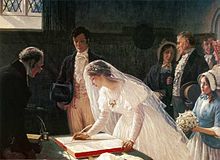

Some cultures have adopted the traditional Western custom of the white wedding, in which a bride wears a white wedding dress and veil. This tradition was popularized through the marriage of Queen Victoria.[one] Some say Victoria's option of a white gown may have only been a sign of extravagance, but may have also been influenced past the values she held which emphasized sexual purity.[ii]
The apply of a wedding band has long been office of religious weddings in Europe and America, just the origin of the tradition is unclear. One possibility is the Roman belief in the Vena amoris, which was believed to be a claret vessel that ran from the 4th finger (ring finger) directly to the centre. Thus, when a couple wore rings on this finger, their hearts were connected. Historian Vicki Howard points out that the belief in the "aboriginal" quality of the practice is nearly probable a modern invention.[3] In the The states, a groom's wedding ceremony band has not appeared until the early 20th century,[four] while in Europe it has been part of the tradition since the ancient Romans, as witnessed past the jurist Gaius.
The exit from the hymeneals ceremony is besides called the "send off", and often includes traditional practices, such as the newlyweds and the hymeneals party bowing and kissing the knees of the elders in Ethiopian weddings. The send off often includes throwing rice (a symbol of prosperity and fertility)[5] or other seeds at the newlyweds in almost of the Western world,[6] as well every bit for example India[5] and Malaysia.[7] Despite fears of the contrary, the apply of uncooked rice for this purpose is not harmful to birds.[8] Shoe tossing in place of rice has too been used in several cultures.[9]

The wedding ceremony is often followed by wedding ceremony reception or a wedding breakfast, in which the rituals may include speeches from a groom, best man, begetter of a bride and possibly a bride,[x] the newlyweds' first trip the light fantastic toe every bit a couple, and the cutting of an elegant wedding ceremony cake. In recent years traditions have changed to include a father-daughter trip the light fantastic for a helpmate and her begetter, and sometimes likewise a female parent-son trip the light fantastic for a groom and his mother.
Traditional wedding attire [edit]
- Western dress lawmaking
- Hymeneals wearing apparel (or conjugal gown), a special clothes worn by a bride.
- Wedding veil, popularized by Queen Victoria, was a long-held custom in which the 'purity' and 'innocence' of the bride could thwart away evil spirits.
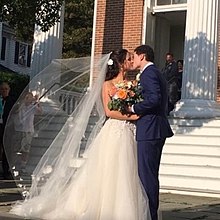
Traditional western nuptials veil
- Forenoon dress, western daytime formal apparel
- White necktie ("evening dress" in the U.K; very formal evening attire)
- Black tie or Evening Suit ("dinner jacket" in the U.K; oftentimes referred to as a "tuxedo" in the U.S; traditionally appropriate only for use subsequently 6:00 p.m.
- Stroller
- Lounge suit
- Non-traditional "tuxedo" variants (colored jackets/ties, "nuptials suits")
- Ao dai, traditional garments of Vietnam
- Barong Tagalog, an embroidered, formal men's garment of the Philippines
- Batik and Kebaya, a garment worn by the Javanese people of Republic of indonesia and also by the Malay people of Malaysia
- Dashiki, the traditional Due west African hymeneals attire
- Dhoti, male garment in South India
- Hanbok, the traditional garment of Korea
- Kilt, male garment particular to Scottish culture[11] [12] [13]
- Kittel, a white robe worn by the groom at an Orthodox Jewish wedding. The kittel is worn only under the chuppah, and is removed before the reception.
- Qun Gua or Kua (裙褂 pinyin qún guà, Cantonese kwàhn kwáa), Chinese traditional formal habiliment. This can exist in the form of a qipao or hanfu.
- Ribbon shirt, often worn by American Indian men on auspicious occasions, such as weddings, some other mutual custom is to wrap bride and groom in a blanket
- Sampot, traditional apparel in Cambodia
- Sari/Lehenga, Indian popular and traditional dress in Republic of india
- Seshweshe, a female person dress worn by the Basotho women during special ceremonies. Although it has recently been adopted to men attire as well.
- Sherwani, a long coat-like garment worn in South asia
- Shiromuku Kimono, a traditional wedding garment in Nihon
- Tiara, or wedding crown, worn past Syrian and Greek couples (which are chosen "τα στέφανα," which literally means "wreaths") and Scandinavian brides
- Topor, a type of conical headgear traditionally worn by grooms as part of the Bengali Hindu wedding ceremony
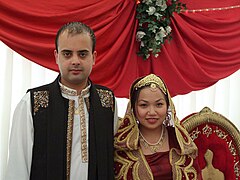
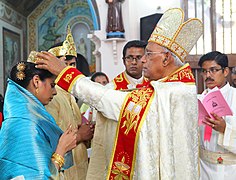
- Unlike nuptials clothing around the world
-

Khmer (Cambodian) wedding in traditional outfits
-

A bride and a bridegroom in Nepal
-
-
-

Japanese bride and bridegroom
-

-

-

-
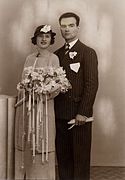
Wedding 1935 in Barcelona, Kingdom of spain
-

-

-
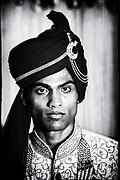
Groom in the traditional dress of Bangladesh in a nuptials.
-

Armenian Wedding ceremony at Khor Virap
-
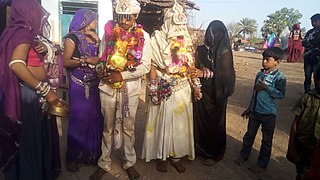
Aadiwasi tribal marriage groom bride, Bharat
Wedding music [edit]
Western weddings [edit]
Music played at Western weddings includes a processional song for walking down the aisle (ex: nuptials march) either earlier or after the marriage service. An case of such use is reported in the wedding of Nora Robinson and Alexander Kirkman Finlay in 1878.[fourteen]
The "Bridal Chorus" from Lohengrin past Richard Wagner, commonly known as "Hither Comes the Bride", is often used as the processional. Wagner is said to have been anti-Semitic,[15] and as a effect, the Conjugal Chorus is usually not used at Jewish weddings.[16] United kingdom law forbids music with any religious connotations to be used in a civil ceremony.[17]
Johann Pachelbel's Catechism in D is an alternative processional.[18] Other alternatives include various contemporary melodies, such as Bob Marley'south 1 Love, which is sometimes performed past a steel drum band.[4] The Music used in modernistic weddings is left completely up to the Bride and Groom and it is also becoming growingly popular for couples to add together their ain twist to the song they walk down the aisle to. Many Brides and Grooms use songs that are sentimental or hold special value to them.
In the U.s.a., approximately 2 million people go married each twelvemonth and shut to seventy meg people attend a wedding and spend more $100 on a gift.[xix]
In the United Kingdom, according to a survey, the average spend minimum spend on a wedding gift is £24.seventy and the boilerplate maximum spend is £111.46. 85% of people said that they were more likely to spend more than money on a person if they had a improve relationship with them.
Religious aspects [edit]
| | This section may need to be rewritten to comply with Wikipedia'due south quality standards, equally the intro to this department is about wedlock and needs to exist rewritten to discuss wedding ceremonies and traditions instead, as does the department on Christian customs. A large corporeality of info in the section on Jewish community is commented out and needs to be incorporated. Sections on other religious customs such as Islamic and Shinto weddings would also exist helpful. (May 2009) |

Nearly religions recognize a lifelong wedlock with established ceremonies and rituals. Some religions permit polygamous marriages or same-sex marriages.
Many Christian faiths emphasize the raising of children as a priority in a marriage. In Judaism, marriage is and then important that remaining unmarried is deemed unnatural.[ citation needed ] Islam too recommends marriage highly; among other things, it helps in the pursuit of spiritual perfection.[ citation needed ] The Baháʼí Faith believes that marriage is a foundation of the structure of lodge, and considers information technology both a physical and spiritual bond that endures into the afterlife.[twenty] Hinduism sees wedlock as a sacred duty that entails both religious and social obligations.[ citation needed ] By dissimilarity, Buddhism does non encourage or discourage union, although it does teach how one might alive a happily married life and emphasizes that marital vows are not to be taken lightly.[ citation needed ]
Different religions accept dissimilar beliefs regarding divorce and remarriage. In Christianity for example, the Roman Catholic Church and Allegheny Wesleyan Methodist Connection believe that marriage is a sacrament and a valid spousal relationship betwixt two baptized persons cannot be broken by any other ways than death.[21] This ways that civil divorcés cannot remarry in a Cosmic marriage or Wesleyan Methodist union while their spouse is alive.[21] In the area of nullity, religions and the country often employ different rules. A couple, for example, may begin the process to have their marriage annulled past the Cosmic Church only after they are no longer married in the optics of the civil potency.
Community associated with various religions and cultures [edit]
Christian customs [edit]

Virtually Christian churches requite some form of blessing to a matrimony, which is seen as a sacred institution in some sense, although terminology and associated theological meanings vary widely from 1 denomination to another: e.one thousand., "holy matrimony," "sacrament of marriage," "holy ordinance of marriage," "holy union," and then forth.
A commemoration of Holy Matrimony typically includes mutual vows or solemn promises of lifelong love and fidelity by the couple, and may include some sort of pledge by the customs to support the couple's relationship. A church wedding is a anniversary held in a church and presided over by a Christian pastor. Traditionally, Christian weddings occur in a church as Christian marriage ideally begins where ane also starts their religion journeying (Christians receive the sacrament of baptism in church in the presence of their congregation).[22] Cosmic Christian weddings must "accept place in a church building" as holy matrimony is a sacrament; sacraments normatively occur in the presence of Christ in the house of God, and "members of the faith customs [should be] present to witness the event and provide support and encouragement for those celebrating the sacrament."[22] Bishops never grant permission "to those requesting to be married in a garden, on the embankment, or another identify outside of the church" and a dispensation is only granted "in extraordinary circumstances (for example, if a helpmate or groom is ill or disabled and unable to come to the church)."[22] Marriage in the church, for Christians, is seen as contributing to the fruit of the newlywed couple regularly attention church each Lord's Day and raising children in the faith.[22]
Wedding ceremonies typically contain prayers and readings from the Holy Bible and reverberate the church building'southward teachings about the spiritual significance of matrimony, every bit well as its purpose and obligations. The wedding service oftentimes includes the reception of Holy Communion, especially in the context of Mass (equally with Catholicism, Lutheranism, and Anglicanism).[23] In some traditional weddings of Western Christianity (especially Catholicism, Lutheranism and Anglicanism), a 'care cloth' or 'nuptial veil' (velatio nuptialis) "signifying a spousal relationship yoke joining the bride and groom together" may be held over the kneeling couple during the nuptial approving given by the priest.[24] [25] [26] [27] [28]
Pre-marital counseling may exist urged or required for the engaged couple.[29] In some Christian countries or denominations, a betrothal rite, as well every bit the reading of banns of marriage may also be required before the wedding ceremony date.[thirty]
In the Roman Catholic Church building, Holy Matrimony is considered to be one of the 7 sacraments, in this case, one that the spouses bequeath upon each other in front of a priest and members of the customs as witnesses. Equally with all sacraments, it is seen every bit having been instituted by Jesus himself (run across Gospel of Matthew xix:1–2, Catechism of the Catholic Church §1614–1615). In the Eastern Orthodox Church, information technology is one of the Mysteries and is seen as an ordination and a martyrdom. The Christian wedding ceremony of Saint Thomas Christians, an ethnoreligious group of Christians in India, incorporates elements from local Indian traditions. Protestant weddings may be elaborate (as with Lutheranism and Anglicanism) or uncomplicated (equally with Baptists). For instance, in the United Methodist Church, the Service of Christian Marriage (Rite I) includes the elements plant in a typical Sunday service, such equally hymns, prayers, and readings from the Bible, too every bit other elements unique to a wedding, including taking marriage vows and an optional exchange of wedding rings, as well as a special benediction for the couple.[31] Holy Communion may be part of the hymeneals service in liturgical Protestant churches (e.g., Lutheran, Anglican, or Methodist), only is rarely, if ever, found in weddings of other low-church Protestant denominations (e.k., Baptists).
A Quaker wedding anniversary in a Friends coming together is like to any other meeting for worship, and therefore often very different from the experience expected by not-Friends.[32]
In some Western countries, a separate and secular civil hymeneals is required for recognition by the state, while in other Western countries, couples must merely obtain a marriage license from a local government authority and can exist married by Christian or other clergy authorized by law to do so.
Since the beginning of the 21st century, same-sex couples have been immune to marry civilly in many countries, and some Christian churches in those countries permit religious marriages of same-sex couples, though some preclude it. See the commodity Same-sex marriage.
Hindu customs [edit]
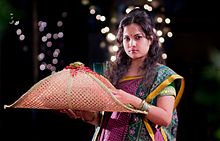
A daughter with the traditional gift of Gaye holud.

Benedict arrives on horseback at a Rajput wedding
Hindu ceremonies are usually conducted totally or at least partially in Sanskrit, the language of the Hindu scriptures. The hymeneals celebrations may terminal for several days and they can be extremely diverse, depending upon the region, denomination, and caste. Mehendi ceremony is a traditional ritual in Hindu weddings, where Henna awarding takes place on the bride's hands and legs, before the wedding. On the wedding day, the bride and the bridegroom garland each other in front of the guests. Most guests witness only this curt anniversary and then socialize, take food, and leave. The religious part (if applicable) comes hours later, witnessed by shut friends and relatives. In cases where a religious ceremony is nowadays, a Brahmin (Hindu priest) arranges a sacred yajna (burn-sacrifice), and the sacred fire (Agni) is considered the prime witness (sākshī) of the marriage. He chants mantras from the Vedas and subsidiary texts while the couple is seated before the fire. The most of import step is saptapadi or saat phere, wherein the bride and the groom, hand-in-paw, encircle the sacred burn 7 times, each circle representing a matrimonial vow. Then the groom marks the bride's hair parting with vermilion (sindoor) and puts a gilded necklace (mangalsutra) around her neck. Or a xanthous thread applied with turmeric is knotted around the helpmate's neck 3 times at marriage. The offset knot represents her obedience and respect to her husband, the 2nd one to his parents and the third represents her respect to God. Several other rituals may precede or follow these afore-mentioned rites. Then the helpmate formally departs from her claret-relatives to join the groom'southward family.
Jewish customs [edit]
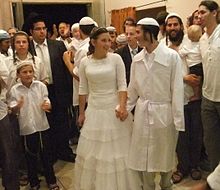
A traditional Jewish wedding ceremony ordinarily follows this format:[33] [34] [35] [36] [37]
- Before the ceremony, the couple formalize a written ketubah (marriage contract), specifying the obligations of husband to the married woman and contingencies in case of divorce. The ketubah is signed by two witnesses and later read under the chuppah (wedding canopy).
- The couple is married under the chuppah signifying their new home together. The chuppah can exist made from a piece of fabric or other fabric attached to four poles, or a giant tallit (prayer shawl) held over the couple past four family unit members or friends.
- The wedding couple is accompanied by both sets of parents and they join the wedding couple nether the chuppah.
- In Orthodox Jewish weddings, the helpmate is accompanied to the chuppah by both mothers, and the groom is accompanied to the chuppah by both fathers.
- Seven blessings are recited, blessing the bride and groom and their new home.
- The couple sip a drinking glass of vino from a Kiddush loving cup.
- The groom will boom a vino glass with his correct human foot, ostensibly in remembrance of the devastation of the 2d Temple.
- In Reform Jewish weddings, the helpmate and groom can smash the wine glass together.
- At some weddings, the couple may declare that each is sanctified to the other, repeat other vows and exchange rings.
- In Orthodox Jewish weddings, the bride does not speak under the chuppah and merely she receives a ring. The groom recites "Harei at mekudeshet li grand'dat Moshe Five'Yisrael"- "behold you are [thus] sanctified to me by the constabulary of Moses and Israel" as he places the band on the bride's right index finger. The bride's silence and acceptance of the ring signify her agreement to the marriage. This part of the ceremony is called kiddushin. The groom's giving an object of value to the bride is necessary for the wedding to exist valid.
- In more egalitarian weddings, the helpmate responds verbally, ofttimes giving the groom a ring in return. A common response is "ani 50'dodi, 5'dodi li" (I am my beloved'south, my love is mine)
- In some Orthodox weddings, the groom and so says:
- "If I forget you, O Jerusalem, may my right hand forget its skill.
- May my tongue cling to the roof of my mouth.
- If I practise not remember you,
- if I do not consider Jerusalem in my highest joy."
- The ceremony ends with the groom breaking a glass underfoot.
- The couple spend their offset moments every bit husband and wife in seclusion (apart from the wedding guests, and with no other person present). This cheder yichud – "the room of seclusion (or 'oneness')" halachically strengthens the marriage bond since Orthodox Jews are forbidden to be secluded with an unrelated person of the opposite sex.
- The ceremony is followed by a seudat mitzvah, the nuptials meal, as well equally music and dancing.
- At the conclusion of the wedding meal, Birkat Hamazon (Grace After Meals) is recited, every bit well as the seven nuptials blessings.
In more observant communities, the couple will celebrate for seven more than days, called the Sheva Brachot (seven blessings) during which the vii hymeneals blessings are recited at every large gathering during this time.
Islamic customs [edit]
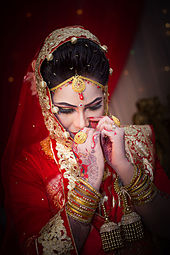

Henna on the hands of a bride in Tunisia
A wedding is typically a happy time for families to celebrate. In the Middle-east, at that place are colorful, cultural variations from place to place.[38]
2 male witnesses who are the members of the family in most cases are required for Nikah. According to the Quran, in a married Muslim couple, both husband and married woman act every bit each other's protector and comforter and therefore only meant "for each other".
All Muslim marriages have to be declared publicly and are never to be undertaken in secret. For many Muslims, information technology is the ceremony that counts as the actual wedding ceremony alongside a confirmation of that wedding in a registry office according to fiqh. In Islam a wedding is also viewed as a legal contract particularly in Islamic jurisprudences. Notwithstanding, most Muslim cultures separate both the institutions of the mosque and spousal relationship; no religious official is necessary, but very often an Imam presides and performs the ceremony, he may deliver a brusk sermon.[39] Celebrations may differ from land to country depending on their culture just the main anniversary is followed by a Walima (the matrimony banquet).
In Islam, polygyny is allowed with certain religious restrictions. Despite that, an overwhelming majority of Muslims traditionally practise monogamy.
Information technology is forbidden in Islam for parents or anyone else: to strength, coerce, or pull a fast one on either man or woman into a spousal relationship that is reverse to the private will of any one of the couples. It is also necessary for all marriages to commence with the best of intentions.
Chinese customs [edit]
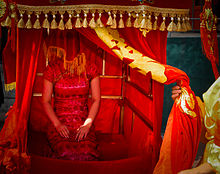
In traditional Chinese nuptials ceremonies, bride arrives in a jiao
At traditional Chinese weddings, the tea ceremony is the equivalent of an substitution of vows at a Western nuptials ceremony. This ritual is nonetheless practiced widely amongst rural Chinese; notwithstanding, young people in larger cities, as well as in Taiwan, Hong Kong, Malaysia, and Singapore, tend to do a combination of Western style of marriage together with the tea ceremony.
When the helpmate leaves her abode with the groom to his firm, a "Good Luck Woman" will agree a cherry umbrella over her caput, meaning, "Enhance the bawl, spread the leaves." This "Good Luck Woman" should exist someone who is blessed with a adept matrimony, healthy children, and husband and living parents. Other relatives will scatter rice, ruddy beans, and dark-green beans in front of her. The crimson umbrella protects the bride from evil spirits, and the rice and beans are to concenter the attention of the gold chicken.[40]
The newlyweds kneel in front end of parents presenting tea. A Good Luck Woman making the tea says cheering phrases to anoint the newlyweds and their families. The newlyweds besides nowadays tea to each other, raising the tea cups high to show respect before presenting the tea to each other.
The attendants receiving the tea normally give the bride gifts such as jewelry or a red envelope.
The tea anniversary is an official ritual to introduce the newlyweds to each other's family, and a way for newlyweds to show respect and appreciation to their parents. The newlyweds kneel in front of their parents, serving tea to both sides of parents, as well as elderberry close relatives. Parents give their words of approval and gifts to the newlyweds.
Humanist weddings [edit]
While many hymeneals traditions and rituals have origins in religions and are still performed by religious leaders, some spousal relationship traditions are cultural and predate the prevalent religions in those regions. Not-religious people will oft want to have a wedding that is secular (not religious) in content. In order to run into this demand, secular ceremonies past carried out by humanist celebrants first adult in the 19th century. Humanists UK members pioneered humanist weddings in the 1890s, and its weddings keep to be popular with couples across England, Wales, and Northern Ireland. In Scotland, Humanist Society Scotland (HSS) has carried out secular ceremonies in the state since the 1980s. These have been legally recognised since 2005,[41] and became more numerous than church weddings in 2018.[42] [43]
Humanist wedding ceremonies are carried out in a variety of countries like the U.S., Canada and recently Brazil, having legal status in merely a few of these countries. Humanist celebrants are able to perform valid ceremonious marriages and civil partnerships in the Commonwealth of Republic of ireland. Secular weddings are becoming more pop in Ireland due to a declining influence of the Catholic Church.[44] Since 2015, Irish humanists have conducted more weddings than the Church building of Ireland.[45]
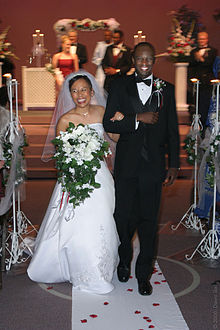
A 2004 California hymeneals between a Filipina helpmate and a Nigerian groom.
Types [edit]
There are many ways to categorize weddings, such as by the size or cultural traditions. A nuptials may fall into several categories, such every bit a destination microwedding, or a civil elopement.
White wedding [edit]

A white nuptials is a term for a traditional formal or semi-formal Western wedding ceremony. This term refers to the color of the nuptials dress, which became popular after Queen Victoria wore a pure white gown when she married Prince Albert and many were quick to copy her choice.[i] At the time, the colour white symbolized both extravagance and virginal purity to many and had become the color for utilize past young women beingness formally presented to the royal court.[two]
Civil wedding [edit]
A ceremonious wedding ceremony is a ceremony presided over by a local ceremonious authorization, such as an elected or appointed judge, Justice of the peace or the mayor of a locality. Civil wedding ceremonies may use references to God or a deity (except in U.K constabulary where readings and music are also restricted), but generally no references to a particular faith or denomination.
Civil weddings allow partners of different faiths to marry without one partner converting to the other partner'southward religion.
They can be either elaborate or simple. Many civil wedding ceremonies take place in local boondocks or metropolis halls or courthouses in judges' chambers.
The relevance of ceremonious weddings varies greatly from country to state. Some countries do not provide whatsoever form of ceremonious wedding at all (State of israel and many Islamic countries), while in others it is the only legally recognized grade of wedlock (most countries in Latin America, Europe, and Asia). In this example civil weddings are typically either a mandatory prerequisite for whatever religious ceremony or religious weddings have no legal significance at all. Run across Ceremonious Union[46]
Destination wedding [edit]
Not to be confused with an elopement, a destination wedding is one in which a wedding is hosted, ofttimes in a vacation-like setting, at a location to which most of the invited guests must travel and often stay for several days. This could be a beach ceremony in the tropics, a lavish event in a metropolitan resort, or a simple ceremony at the home of a geographically distant friend or relative. During the recession of 2009, destination weddings continued to see growth compared to traditional weddings, as the typically smaller size results in lower costs.[47]
Weddings held at prestigious venues such equally castles or stately homes have become increasingly popular in the 21st century especially in European countries such as the UK, France and Frg. From 2010 onwards, there has been an increase in destination weddings that are hosted in exotic places similar Indonesia, Maldives, India, and Pakistan.
Destination weddings are prohibited in certain denominations of Christianity, such every bit the Catholic Church, which teach that Christian marriages should have identify in the presence of God at church, where Christians began their journey of religion in the sacrament of baptism.[22]
Double wedding [edit]
A double wedding is a double ceremony where 2 affianced couples rendezvous for two simultaneous or consecutive weddings. Typically, a fiancé with a sibling who is also engaged, or four close friends in which both couples within the friendship are engaged might programme a double wedding where both couples legally ally.
Elopement [edit]
Elopement is the human action of getting married, often unexpectedly, without inviting guests to the wedding. In some cases, a small grouping of family unit or friends may be present, while in others, the engaged couple may marry without the consent or noesis of parents or others. While the couple may or may not be widely known to be engaged prior to the elopement, the wedding itself is more often than not a surprise to those who are later informed of its occurrence.
Handfasting [edit]
A handfasting is an former infidel custom, dating dorsum to the time of the ancient Celts. A handfasting was originally more similar an engagement flow, where 2 people would declare a bounden marriage between themselves for a year and a day. The original handfasting was a trial marriage.[48]
Highland or Scottish wedding [edit]

The groom and one other in the wedding party wear a kilt with Argyll jacket and long necktie.
A Highland or Scottish wedding has the groom, with some or all of the groom's men vesture a kilt. The bride may wear a sash or other tartan habiliment. The Scottish handbasket sword is used for whatsoever Saber Curvation.
Mass wedding ceremony [edit]
A commonage or mass wedding is a single ceremony where numerous couples are married simultaneously.
Microwedding [edit]
A microwedding is defined by the small number of friends and family unit members present. The number of guests is usually understood to be no more than 10 or 15 people including family members,[49] although some sources volition use this label for a small wedding ceremony with upwardly to l guests.[50] Compared to an elopement or a civil wedding ceremony with no guests, a microwedding is planned and announced in advance and may incorporate whatever traditions and activities the family wants to maintain, such as a wedding cake, photographs, or religious ceremonies.[49] Although the cost per guest may be higher, the overall toll of a microwedding is normally significantly less than a large wedding.[49] [51] Microweddings gained attending during the COVID-19 pandemic as a way to have a wedding effect in compliance with public health restrictions.[52] [53]
War machine wedding [edit]

A armed services wedding is a anniversary conducted in a military machine chapel and may involve a Saber Curvation. In near military weddings one or both of the people getting married will wear a military machine wearing apparel uniform in lieu of noncombatant formal habiliment. Some retired armed services personnel who marry after their service has ended may opt for a military wedding.
Peasant wedding ceremony [edit]
A peasant wedding is a Dutch funfair custom.
Not everywhere in Limburg and Brabant is a boerenbruiloft (peasant'due south wedding) function of the carnival. Specially in the northern and central part of Limburg and eastern part of North Brabant is the boerenbruiloft very often held during the carnival and is an of import part of the carnival culture. Each funfair clan has its own tradition concerning choosing the spouse for a wedding ceremony. Oft the helpmate and groom are chosen by the council of xi or by the couple that was married the yr before. It is non necessary that the newlyweds are a couple in real life. It is also non necessary that the helpmate and groom are single. Both the helpmate and groom, however, should be in beloved during the carnival and they demand to transfer their love to all the people who celebrate their nuptials forth with them. The highlight of the festival of the peasant wedding is the nuptials and banquet of the onecht (not-union) of the bride and groom. There are many aspects that tin can be constitute in a real-life marriage. Commencement the appointment will be appear just as if information technology would be an official marriage. And both the families should larn to know each other very well in organizing the party and the anniversary, similar a normal wedding. The 2 families prepare a slice of entertainment for the wedding.[54] And but like a existent wedding, a reception and a feast is organized where guests are asked to wearable appropriate vesture. The bride and groom will often clothes in wedding clothing from before 1940. The helpmate, for case, will often wear a poffer, which is a traditional Brabantian headdress.[55]
Same-sexual activity wedding [edit]
A marriage between two people of the same sexual activity.
Shotgun wedding [edit]
A shotgun hymeneals is a wedding ceremony in which the groom is reluctant to marry the helpmate, withal, is strongly encouraged to exercise so to avoid family, social or legal repercussions. In many cases, the helpmate is pregnant before the wedding and the family unit of the bride, virtually commonly the helpmate's father insists that the groom ally the bride before the pregnancy becomes obvious.
Vow renewal wedding [edit]
A hymeneals vow renewal is a anniversary in which a married couple renews or reaffirms their wedding ceremony vows. Typically, this anniversary is held to commemorate a milestone wedding anniversary. It may also be held to recreate the marriage ceremony in the presence of family and friends, especially in the case of an earlier elopement.
Weekend wedding [edit]
A weekend hymeneals is a wedding ceremony in which couples and their guests gloat over the course of an unabridged weekend. Special activities, such as spa treatments and golf tournaments may be scheduled into the wedding itinerary. Lodging usually is at the same facility as the wedding and couples often host a Sunday brunch for the weekend's finale.
Wedding ceremony anniversary participants [edit]
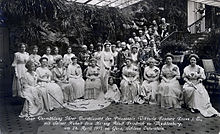
Formal family picture show of a Majestic Wedding.

Waiting for the bride. From left: priest, groom and ushers in New Zealand wearing Scottish kilts.

Wedding ceremony participants also referred to equally the wedding political party, are the people that participate directly in the wedding ceremony itself.
Depending on the location, organized religion, and style of the wedding ceremony, this group may include only the private people that are marrying, or it may include one or more brides, grooms (or bridegrooms), persons of honor, bridespersons, best persons, groomsmen, blossom girls, pages, and band bearers.
A "bride'southward party" consists of those on her side, while a "groom'southward political party" consists of those on his side.
- Bride: A adult female about to be married.
- Bridegroom or Groom: A man nearly to exist married.
- Wedlock officiant: The person who officiates at the hymeneals, validating the wedding from a legal and/or religious standpoint. This person may be a judge, justice of the peace, or a member of the clergy. In Hindu marriages, the marriage officiant is called a pandit or Brahmin.[56]
- Best Human, Woman, or Person: The primary assistant to a benedict at a hymeneals, typically a sibling or friend of special significance in his life. Often holds the nuptials rings until their exchange.
- Mothers of a Bride or Groom
- Fathers of a Bride or Groom
- Maid, Matron or Human of Honor: the title and position held past a bride's primary attendant, typically her closest friend or sibling.
- Bridesmaids: the female attendants to a bride. Males in this role may be called accolade attendants or sometimes bridesmen, but that term has a different traditional meaning.
- Groomsmen or Ushers: The attendants, usually male, to a bridegroom in a wedding ceremony. Female person attendants, such as a sister of the groom, are typically called honor attendants.
- Pages: Young attendants may carry a bride'southward train. In a formal wedding, the band bearer is a special page that carries the rings down the aisle. The coin bearer is a similar folio that marches on the hymeneals aisle to bring the nuptials coins.
- Blossom girls: In some traditions, one or more children acquit bouquets or drop flower petals in front of a bride in the wedding procession.
Wedding industry [edit]
The global nuptials industry was worth $300 billion every bit of 2016. The U.s.a. hymeneals industry alone was estimated to be worth $sixty billion as of the aforementioned year. In the United States, the wedding industry employs over one million people throughout 600,000 businesses and grows 2% each year. The industry has undergone a transition due to the increased use of applied science. Bridal websites, blogs, and social media accounts have driven spending upwardly and created new trends and traditions.[57]
In 2016 lone the average cost of a hymeneals in the U.Due south. was estimated to exist at $35,329,[58] though the average American spent around $14,399[59] that yr. According to one scholarly study of American couples, extravagant spending on weddings is associated with debt stress and brusque-lived marriages that finish in divorce.[lx] Couples who spent less than U.s.a.$10,000 on all nuptials-related expenses, and who had a relatively large number of guests in attendance, were the least likely to divorce.[sixty]
See also [edit]
- Nuptials customs by country
- White hymeneals
- Wedding ceremony dress
- Wedding reception
- Wedding ceremony cake
- Elopement
References [edit]
- ^ a b "Why Practice Brides Wear White?". britannica.com . Retrieved September vii, 2021.
- ^ a b Otnes, Cele & Pleck, Elizabeth (2003). Cinderella Dreams: the Allure of the Lavish Wedding, p. 31. University of California Press, Berkeley.
- ^ Howard, Vicky (2006). Brides Inc.: American Weddings and the Business of Tradition, p. 34. University of Pennsylvania Press, Philadelphia.
- ^ a b Howard, Vicky (2006). Brides Inc.: American Weddings and the Business of Tradition, p. 61. Academy of Pennsylvania Printing, Philadelphia.
- ^ a b B Singh (2013). "Marketing strategies of rice exporters" (PDF).
- ^ Xu, Guobin; Chen, Yanhui; Xu, Lianhua (2018). "Western Folklore". Introduction to Western Culture. pp. 163–187. doi:10.1007/978-981-ten-8153-8_6. ISBN978-981-10-8152-1.
- ^ Abd. Razak Aziz, Awang Azaman Awang Pawi (December i, 2016). "Redefining Malay Nutrient in the Post Malaysia'southward New Economic Policy (NEP)" (PDF). Journal of Tourism, Hospitality & Culinary Arts (JTHCA). 8 (2).
- ^ "Fact or Fiction: Uncooked Rice is Bad for Birds". American Chemical Society. November 5, 2018.
- ^ Britain), Folklore Social club (Great (1895). Publications.
- ^ [1] Archived August 14, 2012, at the Wayback Automobile
- ^ "Kilts: tightly woven into Scots culture". Scotsman. February 10, 2005. Archived from the original on Feb 2, 2007. Retrieved April 16, 2007.
- ^ "The Scottish Kilt". Visit Scotland. Retrieved April 16, 2007.
- ^ Jim Murdoch. "Scottish Culture and Heritage: The Kilt". Scotsmart. Retrieved April 16, 2007.
- ^ "Marriage of Mr A.Thousand. Finlay and Miss Robinson". The Queanbeyan Historic period. NSW. August 14, 1878. p. 1. Retrieved September iv, 2013.
- ^ Cooke, Deryck V. "Richard Wagner | German composer". Britannica.com . Retrieved November ten, 2015.
- ^ Pollack, Suzanne (September 25, 2015) "No Wagner for Yous", Washington Jewish Calendar week. Retrieved December 26, 2019.
- ^ "England and Wales", Music Not Allowed at Civil Ceremonies (article), Wedding Music Designer (Simon Jordan), August xxx, 2015
- ^ Hassall, Jill (2012). "Canon+in+D+by+Pachelbel"&pg=PA53 The Greatest Guide to Your Dream Wedding. Greatest Guides. p. 53. ISBN9781907906060 . Retrieved November 20, 2017.
- ^ Tiffany, Kaitlyn (March 1, 2019). "Why is the wedding industry so hard to disrupt?". Vocalisation . Retrieved March 4, 2019.
- ^ Smith, Peter (2000). "Union". A concise encyclopedia of the Bahá'í Faith. Oxford: Oneworld Publications. pp. 232–233. ISBN1-85168-184-1.
- ^ a b The Discipline of the Allegheny Wesleyan Methodist Connectedness (Original Allegheny Briefing). Salem: Allegheny Wesleyan Methodist Connection. 2014. p. 21.
- ^ a b c d eastward Dooley, Sandra (June 20, 2016). A Guide to Catholic Weddings. Liturgy Training Publications. pp. 29–30. ISBN978-1-61833-134-2.
- ^ "Wedding arrangements". June 23, 2008. Archived from the original on December 16, 2008. Retrieved November 10, 2015.
- ^ Dipippo, Gregory (February eight, 2019). "The Velatio Nuptialis: An Aboriginal (and Forgotten) Part of the Latin Marriage Rite". Novus Motus Liturgicus. Retrieved January 23, 2022.
- ^ Olavus Petri (1929). The Evangelical Lutheran Church Transmission of Olavus Petri: A Manual in Swedish, Including Baptism, Etc. Lutheran Augustana Book Concern.
- ^ Hopkins, Samuel Miles (1883). Full general Liturgy and Book of Mutual Prayer. A.S. Barnes. p. 135.
- ^ Monger, George (2004). Marriage Customs of the World: From Henna to Honeymoons. ABC-CLIO. p. 53. ISBN978-1-57607-987-4.
- ^ Warner, Diane (Nov 25, 2013). Diane Warner's Complete Guide to a Traditional Wedding ceremony: Time-Tested Toasts, Vows, Ceremonies & Etiquette: Everything Y'all Need to Create Your Perfect Twenty-four hours. Red Bike. ISBN978-one-60163-494-8.
- ^ The Book of Worship for Church and Home: With Orders of Worship, Services for the Administration of the Sacraments and Other Aids to Worship According to the Usages of the Methodist Church. Methodist Publishing House. 1964. p. 32. Retrieved March 25, 2017.
- ^ Tucker, Karen B. Westerfield (April 27, 2011). American Methodist Worship. Oxford Academy Printing. p. 188. ISBN9780190454203.
- ^ "A Service of Christian Marriage". Discipleship Ministries. 1992. Retrieved March 28, 2017.
- ^ The Alternative Wedding Volume. Wood Lake Publishing Inc. 1995. p. 40. ISBN978-1-55145-081-0.
- ^ "Guide to the Jewish Wedding". Retrieved July 3, 2008.
- ^ "Nissuin: The 2d of the Two Ceremonies". Retrieved July three, 2008.
- ^ "Understanding the Jewish Wedding". Archived from the original on September 21, 2007. Retrieved July three, 2008.
- ^ "Ceremony: Jewish Wedding ceremony Rituals". Retrieved July 3, 2008.
- ^ "Marriage in Jewish Art". Retrieved July 3, 2008.
- ^ Dodge, Christine Huda. "Islamic Wedding Party Community". About.com. Retrieved June 8, 2013.
- ^ "Religions – Islam: Weddings". BBC. Retrieved Nov 10, 2015.
- ^ Siu, Tyrone. "Chicken ceremony rooted in ancient rites". Retrieved July 8, 2018.
- ^ "Humanist Society Scotland | Celebrate the one life we have". Humanism-scotland.org.uk. Baronial 28, 2015. Retrieved November ten, 2015.
- ^ "Scottish humanists to overtake Kirk weddings". BBC Scotland. June 18, 2015. Retrieved May 31, 2017.
- ^ Brocklehurst, Steven (Baronial 2016). "More 4200 Humanist weddings took identify in Scotland last year". Humanist Lodge Scotland . Retrieved May 31, 2017.
- ^ Walsh, Fionnuala (April 11, 2019). "Less than one-half of Irish weddings are Catholic". The Times. Archived from the original on April 18, 2019. Retrieved May 22, 2019.
- ^ "Success! Couple win challenge to lack of legal recognition of humanist marriages in Northern Ireland". Humanists United kingdom. June 9, 2017. Retrieved June 9, 2017.
- ^ for details. Gavira, Juan. "Characteristics of a Spanish wedding" Archived March 3, 2016, at the Wayback Motorcar. Juangavira.com
- ^ Parsons, Claudia (May 12, 2009). "Destination weddings run across growth despite recession". Reuters . Retrieved Nov x, 2015.
- ^ "About Handfastings". Handfastings.org. Retrieved November ten, 2015.
- ^ a b c Goldfarb, Anna (October 12, 2017). "What to Know Almost Having a Microwedding". The New York Times. ISSN 0362-4331. Retrieved January 17, 2021.
- ^ Mackey, Jaimie (April 15, 2020). "What Is a Micro Wedding and Should You Have One?". Brides . Retrieved January 17, 2021.
- ^ Midland, Cary (October 8, 2018). "What's a Micro Wedding ceremony, and Why Are They Becoming So Popular?". Martha Stewart . Retrieved Jan 17, 2021.
- ^ Velez, Mandy (July 6, 2020). "COVID-19 Didn't Kill Weddings. Merely It May Change Them Forever". The Daily Beast . Retrieved January 17, 2021.
- ^ Rello, Gabriella (July 13, 2020). "How to Plan a Beautiful, Meaningful Micro Wedding And so That You Tin Celebrate Your Postponed Wedding Right Now". Martha Stewart . Retrieved Jan 17, 2021.
- ^ "Wedding ceremony Twenty-four hours Invitation Styles and Designs – A Vintage Approach". Houseplantation. December x, 2015. Archived from the original on Jan 21, 2016. Retrieved August 26, 2016.
- ^ "Boerenbruiloft: hoezo in het 'onecht' verbonden? | Vastelaovend en Carnaval in Limburg". Vastelaovendinlimburg.nl. April 8, 2013. Retrieved October 29, 2013.
- ^ Britannica, The Editors of Encyclopaedia (February 23, 2021). "Brahman". Encyclopedia Britannica . Retrieved January 21, 2022.
- ^ "Part 1: The Past, Present and Futurity of the Nuptials Industry". HuffPost. February 24, 2016.
- ^ Lui, Kevin. "This Is How Much It Now Costs to Get Married in the U.Due south. on Average". Fortune . Retrieved June thirty, 2017.
- ^ 2016 U.S. Median Cost of a Hymeneals was $14,399, The Wedding Institute, retrieved September ane, 2017
- ^ a b Francis-Tan, Andrew; Mialon, Hugo M. (September 15, 2014). "'A Diamond is Forever' and Other Fairy Tales: The Relationship between Wedding Expenses and Wedlock Duration". Rochester, NY. doi:10.2139/ssrn.2501480. S2CID 44741655. SSRN 2501480.
External links [edit]
-
 The dictionary definition of wedding ceremony at Wiktionary
Source: https://en.wikipedia.org/wiki/Wedding
0 Response to "Do I Go to Wedding of My Ex Family"
Post a Comment