Ten Different Families Are Tested for the Number of Gallons
Topic 4 Part ii: Applications of Supply and Need
4.vii Taxes and Subsidies
Learning Objectives
By the cease of this section, yous will be able to:
- Distinguish betwixt legal and economic tax incidence
- Know how to represent taxes by shifting the curve and the wedge method
- Understand the quantity and price affect from a tax
- Describe why both taxes and subsidies cause deadweight loss
Taxes are non the most popular policy, only they are frequently necessary. We will wait at two methods to understand how taxes affect the market: by shifting the curve and using the wedge method. Outset, we must examine the difference betwixt legal tax incidence and economical tax incidence.
Legal versus Economic Tax Incidence
When the government sets a tax, it must decide whether to levy the tax on the producers or the consumers. This is calledlegal taxation incidence. The most well-known taxes are ones levied on the consumer, such equally Government Sales Tax (GST) and Provincial Sales Tax (PST). The government too sets taxes on producers, such as the gas taxation, which cuts into their profits. The legal incidence of the taxation is actually irrelevant when determining who is impacted past the taxation. When the government levies a gas taxation, the producers volition pass some of these costs on equally an increased toll. Likewise, a tax on consumers volition ultimately decrease quantity demanded and reduce producer surplus. This is considering the economic tax incidence, or who really pays in the new equilibrium for the incidence of the revenue enhancement, is based on how the market responds to the price alter – not on legal incidence.
Tax – Shifting the Curve
In Topic iii, nosotros determined that the supply bend was derived from a house'southward Marginal Price and that shifts in the supply curve were caused by whatsoever changes in the market that caused an increase in MC at every quantity level. This is no different for a tax. From the producer's perspective, any tax levied on them is just an increase in the marginal costs per unit. To illustrate the effect of a tax, let's look at the oil market over again.
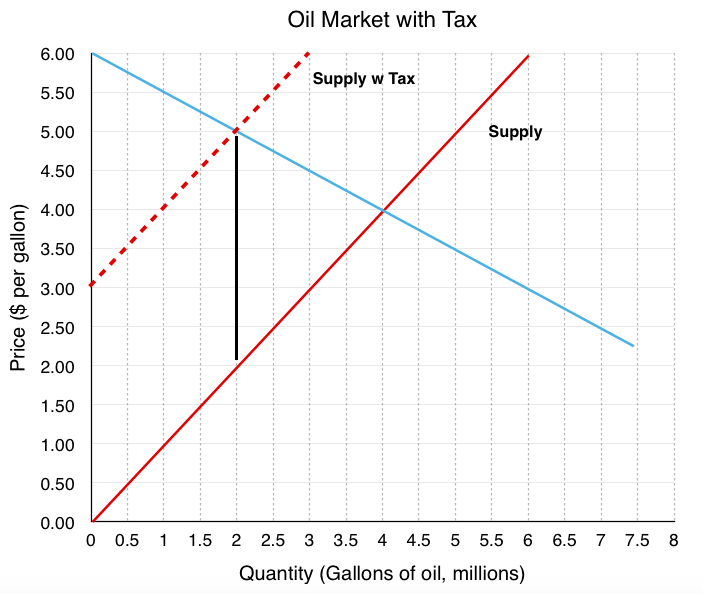
If the regime levies a $3 gas tax on producers (a legal tax incidence on producers), the supply curve will shift up past $3. Every bit shown in Effigy four.8a below, a new equilibrium is created at P=$5 and Q=two million barrels. Note that producers do not receive $v, they now only receive $two, as $3 has to be sent to the government. From the consumer's perspective, this $1 increment in price is no different than a price increase for whatever other reason, and responds past decreasing the quantity demanded for the higher priced proficient.
What if the legal incidence of the tax is levied on the consumers? Since the need curve represents the consumers' willingness to pay, the demand curve volition shift downwardly as a consequence of the tax. If consumers are but willing to pay $4/gallon for iv one thousand thousand gallons of oil but know they will confront a $3/gallon tax at the till, they will only purchase iv 1000000 gallons if the ticket price is $i. This creates a new equilibrium where consumers pay a $2 ticket toll, knowing they will take to pay a $3 tax for a total of $5. The producers will receive the $2 paid before taxes.
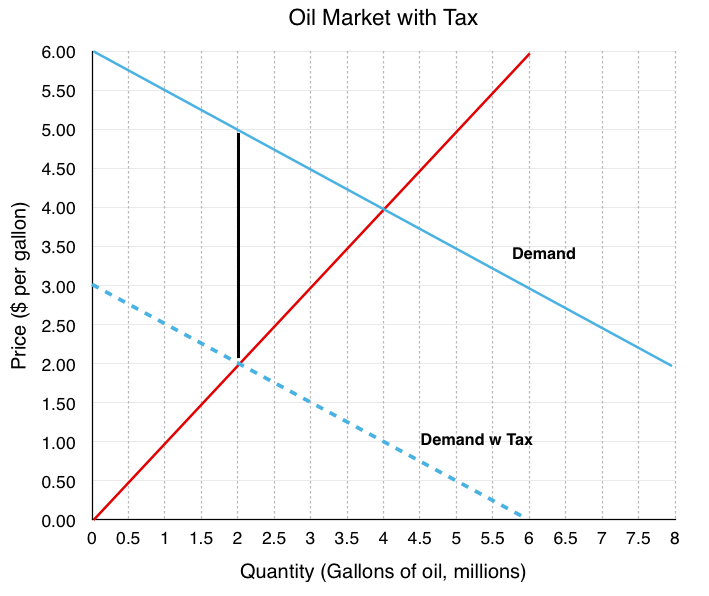
Note that whether the tax is levied on the consumer or producer, the final consequence is the aforementioned, proving the legal incidence of the taxation is irrelevant.
Tax – The Wedge Method
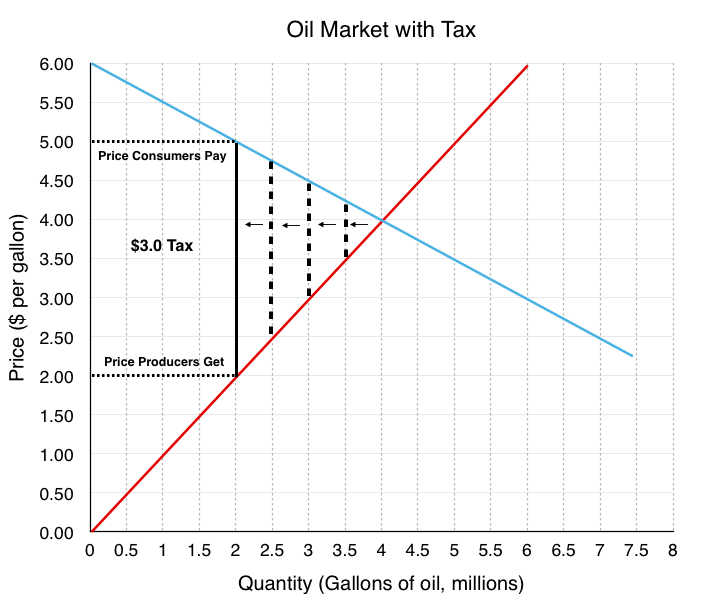
Another method to view taxes is through the wedge method. This method recognizes that who pays the tax is ultimately irrelevant. Instead, the wedge method illustrates that a tax drives a wedge between the price consumers pay and the revenue producers receive, equal to the size of the revenue enhancement levied.
Equally illustrated beneath, to find the new equilibrium, one simply needs to find a $3 wedge between the curves. The first wedge tested is only $0.seven, followed by $1.5, until the $3.0 tax is found.
Market Surplus
Like with cost and quantity controls, one must compare the market surplus earlier and after a cost alter to fully understand the effects of a tax policy on surplus.
Before
The marketplace surplus earlier the tax has non been shown, as the process should be routine. Ensure you understand how to get the following values:
Consumer Surplus= $4 one thousand thousand
Producer Surplus = $8 one thousand thousand
Marketplace Surplus = $12 million
After
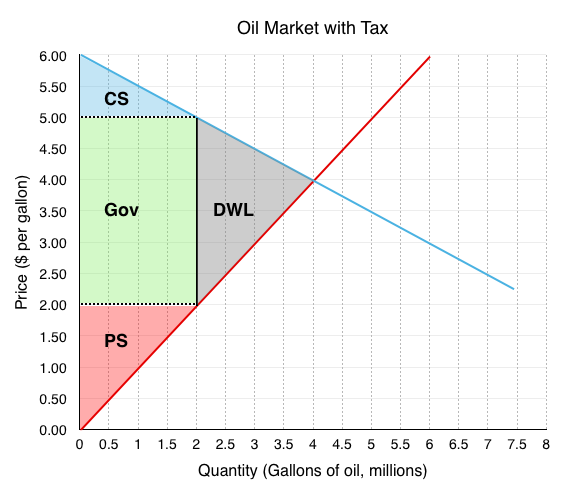
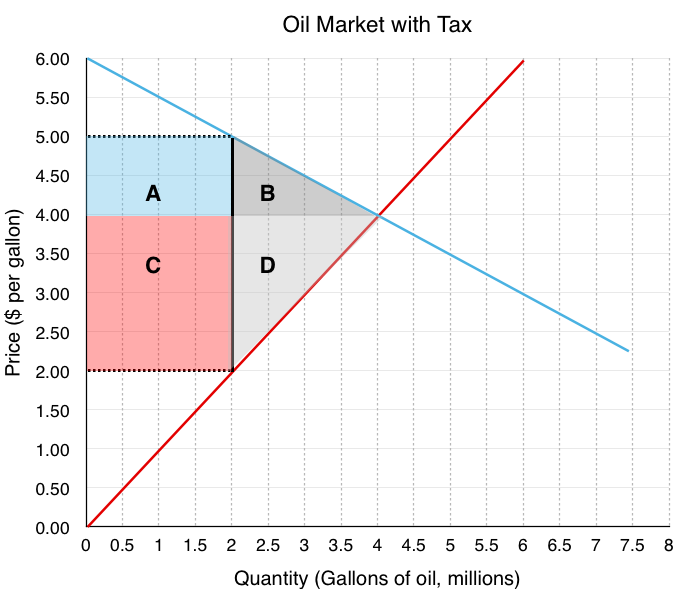
The market place surplus subsequently the policy can be calculated in reference to Figure 4.7d
Consumer Surplus (Blue Area) = $1 million
Producer Surplus (Cherry-red Area)= $2 million
Government Revenue (Greenish Area) = $6 million
Market Surplus= $ix million
Why is Government Included in Market place Surplus
In our previous examples dealing with market place surplus, we did not include whatsoever give-and-take of government revenue, since the government was non engaging in our market. Call up that market surplus is our metric for efficiency. If government was non included in this metric, it would not be very useful. In this case a million-dollar loss to government would exist considered efficient if it resulted in a $1 gain to a consumer. To ensure that our metric for efficiency is still useful nosotros must consider authorities when calculating marketplace surplus.
As with the quota – both consumer and producer surplus decreased because of a reduced quantity. The difference is, since the price is irresolute, in that location is redistribution. This time, the redistribution is from consumers and producers to the regime. Retrieve, only a change in quantity causes a deadweight loss. Toll changes just shift surplus effectually betwixt consumers, producers, and the government.
Transfer and Deadweight Loss
Let's look closely at the taxation'southward impact on quantity and price to see how these components affect the market place.
Transfer – The Impact of Toll
Due to the tax's consequence on price, areas A and C are transferred from consumer and producer surplus to government revenue.
Consumers to Government – Area A
Consumers originally paid $4/gallon for gas. Now, they are paying $5/gallon. The $1 increase in price is the portion of the tax that consumers have to conduct. Despite the fact that the taxation is levied on producers, the consumers have to bear a share of the price change. The size of this share depends on relative elasticity – a concept we will explore in the next section. This is because a decrease in cost to producers means quantity supplied is falling, and in order to maintain equilibrium, quantity demanded must fall by an equal corporeality. This cost change means the government collects $i ten ii million gallons or $2 million in tax revenue from the consumers. This is a straight transfer from consumers to government and has no issue on market place surplus.
Producers to Government – Expanse C
Originally, producers received revenue of $4/gallon for gas. At present, they receive $2/gallon. This $two decrease is the portion of the tax that producers have to carry. This means that the government collects $2 x ii million gallons or $4 million in tax revenue from the producers. This is a transfer from producers to the government.
Every bit calculated, the authorities receives a full of $6 million in tax acquirement, which is taken from consumers and producers. This has no impact on internet market surplus.
Deadweight Loss – The Bear upon of Quantity
If we just considered a transfer of surplus, there would exist no deadweight loss. In this case, though, we know that price changes come with a modify in quantity. A higher price for consumers will cause a decrease in the quantity demanded, and a lower price for producers volition cause a decrease in quantity supplied. This reduction from equilibrium quantity is what causes a deadweight loss in the market since in that location are consumers and producers who are no longer able to buy and supply the good.
Consumer Surplus Decrease – Area B
Due to the increase in cost, many consumers volition switch away from oil to alternative options. This decrease in quantity need of 1.5 million gallons of oil causes a deadweight loss of $1 1000000.
Producer Surplus Decrease – Area D
Producers, who now receive simply $ii.00/gallon for their product, will also subtract quantity supplied past 1.5 1000000 gallons of oil. Information technology is no coincidence that the size of the decrease is the aforementioned. When you create the wedge between consumers and producers, you lot are finding the quantity where the full corporeality of the tax is incurred merely the market is notwithstanding at equilibrium. Think that quantity demanded must equal quantity supplied or the market will non be stable. This mirrored subtract in quantity ensures this is still the case. Find, all the same, that the impact of this quantity driblet causes a larger decrease in producer surplus than consumer surplus totalling $ii million. Over again, this is due to elasticity, or the relative responsiveness to the price hazard, which volition be explored in more detail shortly.
Together, these decreases crusade a $3 million deadweight loss (the difference between the market surplus before and market place surplus later).
Subsidy
While a tax drives a wedge that increases the price consumers have to pay and decreases the toll producers receive, a subsidy does the opposite. Asubsidy is a benefit given by the government to groups or individuals, unremarkably in the grade of a cash payment or a taxation reduction. A subsidy is often given to remove some type of burden, and information technology is oftentimes considered to be in the overall interest of the public. In economic terms, a subsidy drives a wedge, decreasing the price consumers pay and increasing the price producers receive, with the government incurring an expense.
In Topic 3, we looked at a case study of Victoria's competitive housing marketplace where high demand drove up prices. In response, the regime has enacted many policies to allow depression-income families to still go homeowners. Permit's expect at the furnishings of one possible policy. (Note the following policy is unrealistic just allows for easy comprehension of the effect of subsidies).
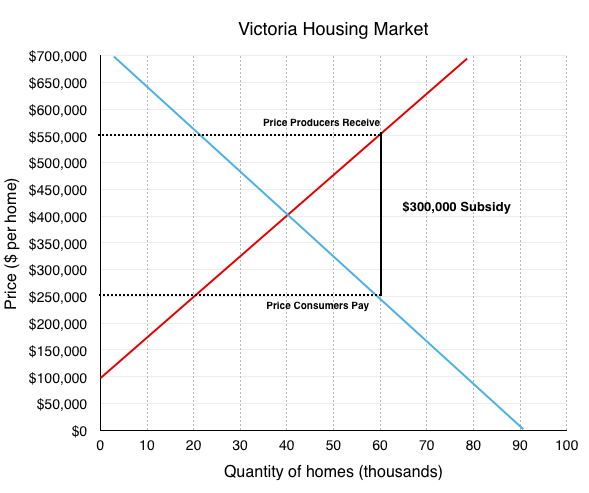
In the market place above, our efficient equilibrium begins at a cost of $400,000 per home, with 40,000 homes beingness purchased. The government wants to essentially increase the number of consumers able to purchase homes, so it problems a $300,000 subsidy for whatever consumers purchasing a new home. This drives a wedge between what home buyers pay ($250,000) and what habitation builders receive ($550,000).
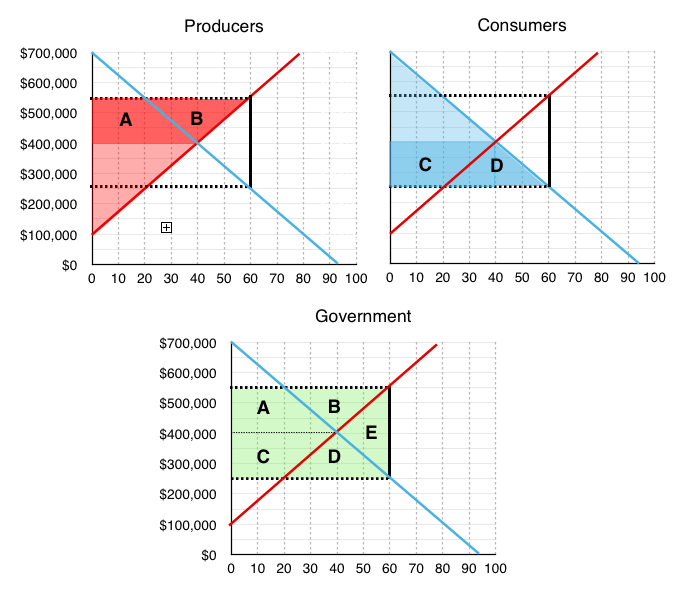
With all government policies we accept examined so far, we accept wanted to determine whether the consequence of the policy increases or decreases market surplus. With a subsidy, we desire to do the same analysis. Unfortunately, because increases in surplus overlap on our diagram, it becomes more complicated. To simplify the analysis, the following diagram separates the changes to producers, consumers, and regime onto different graphs.
Producers
The producers now receive $550,000 instead of $400,000, increasing quantity supplied to sixty,000 homes. This increases producer surplus byareas A and B.
Consumers
The consumers now pay $250,000 instead of $400,000, increasing quantity demanded to 60,000 homes. This increases consumer surplus byareas C and D.
Regime
The regime now has to pay $300,000 per domicile to subsidize the 60,000 consumers buying new homes (this policy would toll the government $xviii billion!!) Graphically, this is equal to a decrease in government to areas A, B, C, D and E.
Result
Our total gains from the policy (to producers and consumers) are areasA, B, C and D,whereas full losses (the cost to the government) are areasA, B, C, D, and Due east.To summarize:
AreasA, B, C and D are transferred from the regime to consumers and producers.
Area E is a deadweight loss from the policy.
There are two things to notice about this instance. Commencement, the policy was successful at increasing quantity from twoscore,000 homes to lx,000 homes. 2d, information technology resulted in a deadweight loss considering equilibrium quantity was likewise loftier. Remember,anytime quantity is changed from the equilibrium quantity, in the absence of externalities, there is a deadweight loss. This is true for when quantity is decreased and when it is increased.
http://www.investopedia.com/terms/s/subsidy.asp
Summary
Taxes and subsidies are more complicated than a price or quantity control as they involve a third economic player: the government. As nosotros saw, who the revenue enhancement or subsidy is levied on is irrelevant when looking at how the market ends up. Note that the last iii sections have painted a fairly grim picture nigh policy instruments. This is because our model currently does not include the external costs economical players impose to the macro-environment (pollution, disease, etc.) or attribute any meaning to equity. These concepts will be explored in more detail in later topics.
In our examples above, we run into that the legal incidence of the revenue enhancement does non matter, merely what does? To make up one's mind which party bears more than of the burden, we must employ the concept of relative elasticity to our analysis.
Glossary
- Economic Taxation Incidence
- the distribution of tax based on who bears the burden in the new equilibrium, based on elasticity
- Legal Tax Incidence
- the legal distribution of who pays the tax
- Subsidy
- a benefit given by the government to groups or individuals, ordinarily in the grade of a cash payment or a tax reduction It is frequently to remove some type of brunt, and it is often considered to be in the overall involvement of the public
Exercises 4.7
Refer to the supply and demand curves illustrated beneath for the following THREE questions. Consider the introduction of a $twenty per unit revenue enhancement in this market.
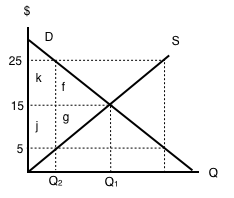
i. Which areas stand for the loss to consumer AND producer surplus as a consequence of this tax?
a) k + f.
b) j + g.
c) k + j.
d) k + f + j + k.
two.Which areas represent the gain in government revenue every bit a issue of this tax?
a) k + f.
b) j + g.
c) k + j.
d) k + f + j + g.
3. Which areas represent the deadweight loss associated with this tax?
a) f + g.
b) k – k.
c) j – f.
d) k + f + j + m.
4. Assume that the marginal cost of producing socks is constant for all sock producers, and is equal to $5 per pair. If government introduces a abiding per-unit revenue enhancement on socks, and then which of the post-obit statements is False, given the after-tax equilibrium in the sock market? (Assume a downward-sloping need bend for socks.)
a) Consumers are worse off as a consequence of the tax.
b) Spending on socks may either increase or subtract as a event of the revenue enhancement.
c) Producers are worse off as a event of the tax.
d) This tax will upshot in a deadweight loss.
5. Refer to the supply and demand diagram below.
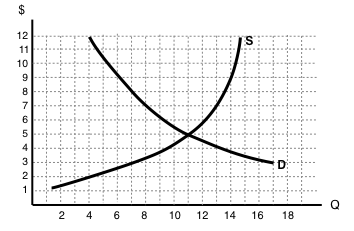
If an subsidy of $3 per unit is introduced in this marketplace, the price that consumers pay will equal ____ and the toll that producers receive net of the subsidy will equal _____.
a) $2; $5.
b) $iii; $6.
c) $4; $seven.
d) $5; $8.
half dozen. If a subsidy is introduced in a market, then which of the post-obit statement is TRUE? Assume no externalities
a) Consumer and producer surplus increase but social surplus decreases.
b) Consumer and producer surplus subtract but social surplus increases.
c) Consumer surplus, producer surplus, and social surplus all increase.
d) Consumer surplus, producer surplus, and social surplus all decrease
Utilise the diagram below to answer the following 2 questions.
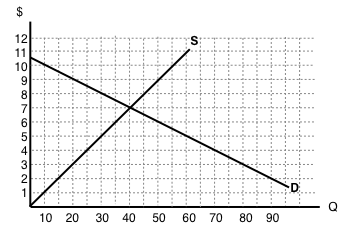
7. If a $6 per unit taxation is introduced in this market place, then the price that consumers pay will equal ____ and the price that producers receive net of the tax will equal _____.
a) $ten; $four.
b) $nine; $3.
c) $8; $2.
d) $7; $1.
8. If a $6 per unit tax is introduced in this market place, so the new equilibrium quantity will be:
a) twenty units.
b) 40 units.
c) 60 units.
d) None of the above.
9. Which of the post-obit statements about the deadweight loss of tax is TRUE? (Assume no externalities.)
a) If there is a deadweight loss, then the acquirement raised by the tax is greater than the losses to consumer and producers.
b) If there is no deadweight loss, and then revenue raised by the government is exactly equal to the losses to consumers and producers.
c) Both a) and b).
d) Neither a) nor b).
ten. Which of the following correctly describes the equilibrium effects of a per-unit tax, in a market with NO externalities?
a) Consumer and producer surplus increase but social surplus decreases.
b) Consumer and producer surplus decrease but social surplus increases.
c) Consumer surplus, producer surplus, and social surplus all increase.
d) Consumer surplus, producer surplus, and social surplus all decrease.
xi. Which of the following correctly describes the equilibrium effects of a per unit subsidy?
a) Consumer price rises, producer price falls, and quantity increases.
b) Consumer price falls, producer price falls, and quantity increases.
c) Consumer price rises, producer price rises, and quantity increases.
d) Consumer price falls, producer price rises, and quantity increases.
12. Refer to the supply and demand diagram below.
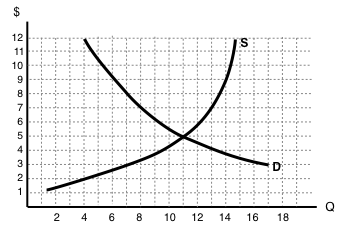
If an output (excise) tax of $5 per unit of measurement is introduced in this marketplace, the price that consumers pay volition equal ____ and the price that producers receive net of the taxation volition equal _____.
a) $v; $10.
b) $6; $11.
c) $seven; $12.
d) $viii; $three.
xiii. Consider the supply and demand diagram below.
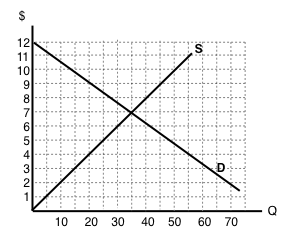
If a $2 per unit subsidy is introduced, what will exist the equilibrium quantity?
a) 40 units.
b) 45 units.
c) 50 units.
d) 55 units.
Consider the supply and demand diagram below. Assume that: (i) at that place are no externalities; and (2) in the absence of regime regulation the marketplace supply curve is the one labeled S1.
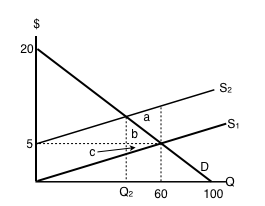
14. If a $v per unit tax is introduced in this market, which area represents the deadweight loss?
a) a.
b) a + b.
c) b + c.
d) a + b + c.
Source: https://pressbooks.bccampus.ca/uvicecon103/chapter/4-6-taxes/
0 Response to "Ten Different Families Are Tested for the Number of Gallons"
Post a Comment